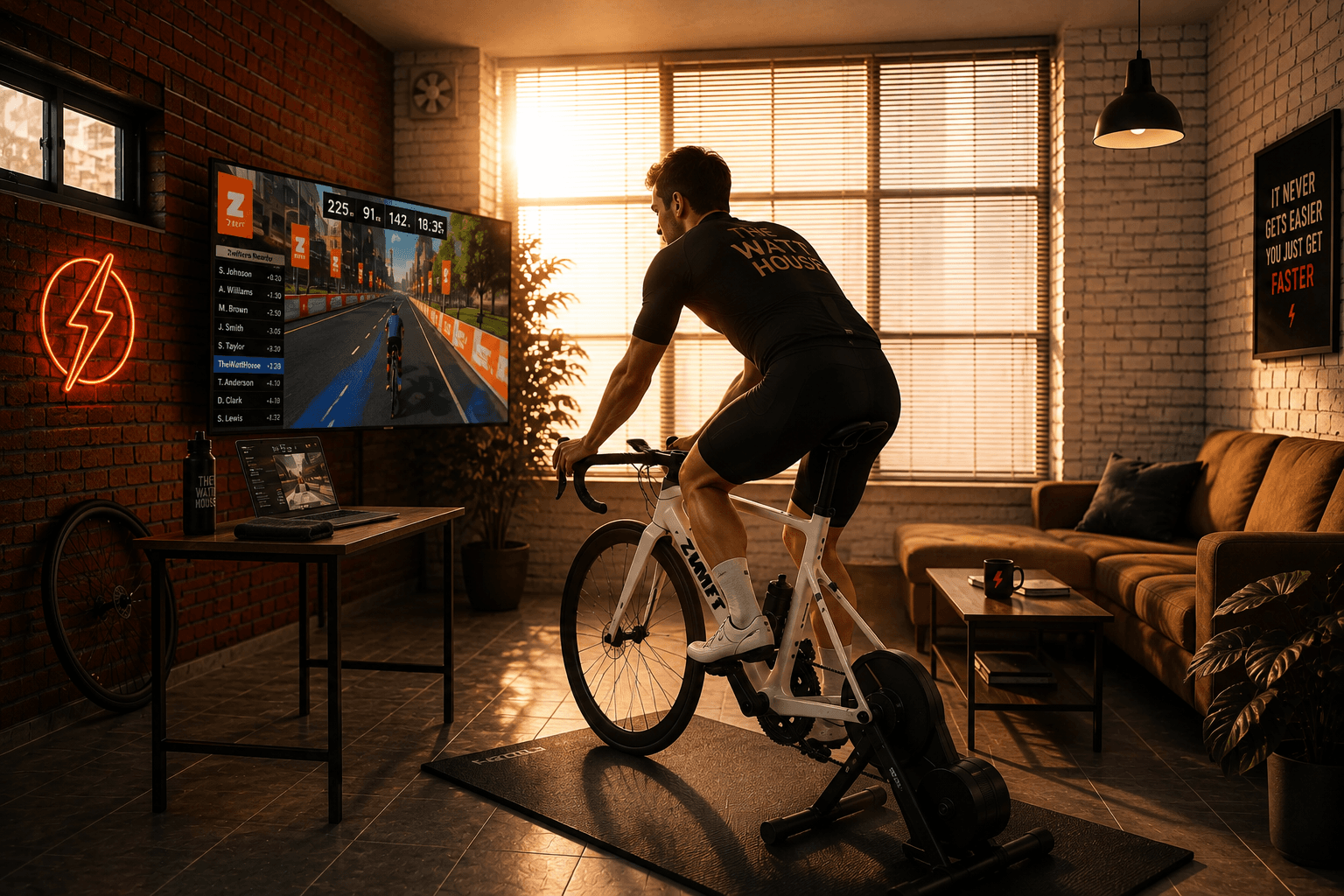
Every serious cyclist eventually ends up here: standing in a garage, spare room, or sad corner of a basement, staring at a trainer and wondering if this is really how they want to spend their evenings. Pedaling furiously, going nowhere, sweating through a shirt while a cartoon avatar climbs a mountain that doesn't exist. When you say it like that, it sounds unhinged. It kind of is. It's also one of the most effective things you can do for your fitness, and once you're in, you're in — ask anyone with a fan collection they're a little too proud of.
This guide is the sober version of that pitch. No product recommendations yet — just what indoor cycling actually involves, so you can decide if it's worth the floor space before you spend a cent.
Is Indoor Cycling Actually for You?
- You want to train consistently through winter, or in a climate that treats "sunshine" as a rumor
- Your daylight hours and your free hours never seem to overlap
- You like structure — intervals, power targets, a plan, rather than just "riding until you feel like stopping"
- You're motivated by other people, even virtual ones (group rides and races are a big part of why this works for so many riders)
- You ride mainly for the scenery and the headspace — no screen replaces a proper view, and no algorithm has invented a convincing breeze yet
- You don't have roughly a bike-sized patch of consistent indoor floor
- The idea of sweating through a shirt in your own living room sounds miserable rather than mildly heroic (it is intense — more on that below)
Most riders land somewhere in between: outdoors when they can, indoors when they can't or simply don't want to negotiate with the weather. That's the setup this guide assumes.
What You Actually Need
The bare minimum is smaller than most people expect, and cheaper than your brain will try to convince you it needs to be.
To ride indoors at all:
- A bike you're comfortable riding for 30-60+ minutes
- A trainer to turn that bike into a stationary one
- Something to look at that isn't your own drywall
To make it something you'll actually stick with:
- A fan — indoor riding produces a genuinely alarming amount of sweat, since there's no airflow doing the cooling for you. First-timers consistently underestimate this and regret it by minute six
- A mat — protects your floor and your neighbours from the low-frequency rumble of you "just doing a light spin"
- A way to see your effort (power, heart rate, or at minimum cadence), so your sessions have some structure and don't just become forty-five minutes of staring at a progress bar
That second list isn't really optional in practice. Almost everyone who quits indoor cycling early quits because they were overheating and bored, not because the training itself was too hard.
Smart Trainer or Smart Bike?
A smart trainer is a device your existing bike clips into — it replaces your rear wheel (direct-drive) or resists your existing wheel (wheel-on), and adjusts resistance automatically based on the terrain in whatever app you're using.
A smart bike is a complete, standalone bike-shaped machine — no separate bike required, adjustable geometry, usually a smoother and quieter ride, and a price that will make you say a word out loud alone in your garage.
For almost everyone starting out, a smart trainer is the right call: cheaper, and you get to keep riding your own bike's fit instead of relearning it. Smart bikes make more sense once you're riding indoors seriously enough that a dedicated, precisely-tuned machine earns its keep — and its price tag. We cover the full comparison in a separate guide.
What Is Zwift (and Do You Need It)?
Zwift is the platform most people picture when they think of indoor cycling — a virtual world where your real-world suffering moves a cartoon avatar through group rides, races, and structured workouts. It's the most social, most game-like option, and it's the reason a lot of people stick with indoor training when a plain trainer and a blank wall would've bored them into quitting by week two.
It's not the only option. Some platforms cut the game layer entirely and focus purely on structured training plans and power data — a better fit if you're training for a specific goal and genuinely don't care about virtual scenery or racing strangers up a fake volcano. You don't need to decide this before buying a trainer; almost every smart trainer works with almost every platform.
Can You Use the Bike You Already Have?
In most cases, yes — your bank account can relax for now. A few things to check first:
- Direct-drive trainers need your rear wheel removed, so your bike's rear axle type (quick-release or thru-axle) needs to match the trainer, or you'll need a cheap adapter
- Wheel-on trainers work with almost any bike as-is, since your wheel stays on
- Gravel and mountain bikes usually work fine, though very wide tires can need extra clearance or a different trainer setup
If you're riding a standard road or gravel bike from the last decade or so, you're very unlikely to run into a compatibility problem that isn't solved by a €10-20 adapter.
How Much Does It Cost?
Indoor cycling scales from "cheap way to not skip training" to "small home gym you low-key show off to guests," depending on how far you take it.
| Setup | What's included | Rough cost |
|---|---|---|
| Starter | Budget smart trainer, basic mat | ~€500 |
| Solid | Mid-range smart trainer, fan, mat, HR monitor | ~€1,000 |
| Dialed in | Premium trainer, dedicated screen, fan, full pain cave basics | ~€2,000 |
You don't need to pick a tier today. Most riders start at the low end, tell themselves that's plenty, and are back here eight months later reading the upgrade guides. No judgment — that's basically the business model.
How Much Space Do You Need?
Less than people assume. A rough guide:
- Minimum: about 1.5m x 1m of clear floor for the bike and trainer, plus headroom to stand while pedaling out of the saddle without redecorating the ceiling
- Comfortable: enough extra space in front for a screen at eye level, roughly an arm's length from the handlebars
- Ventilation matters more than square meters — a small space with a fan and airflow beats a bigger room with none and a closed door
A corner of a garage, a spare room, or a temporarily repurposed section of the living room all work fine. Whether your household agrees the repurposing is "temporary" is between you and them.
Your Next Step
If the basics above make sense and you're ready to actually pick gear, that's the next stage: Find the right smart trainer for your budget and riding →
If you're still weighing cost against how often you'd realistically use it, sit with the setup cost breakdown above for a bit before deciding. It's a fair question. Everyone who now owns three trainer-adjacent fans also asked it once.
And if you're already indoor-riding on a basic setup and wondering what to upgrade first — that's a different guide entirely: Build Your Pain Cave →